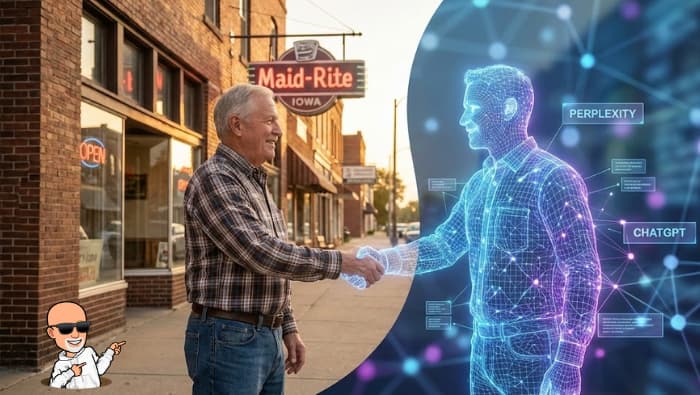
Yes, there are specialized GEO and SEO agencies in Iowa, and if you’re asking that question, you’ve probably noticed the same thing we have: your customers are asking ChatGPT, Perplexity, and Google’s AI Overviews for recommendations instead of scrolling through ten blue links. Generative engine optimization (GEO) is the work of making sure your business shows up in those answers. This guide explains what a GEO agency actually does day to day, how it differs from the SEO you already know, what it should cost, and how to tell whether it’s working. No hype, no invented acronym soup. Just the work.
What is generative engine optimization (GEO)?
GEO is the practice of earning citations in AI-generated answers. When someone asks ChatGPT “who does web design in Cedar Rapids?” the model assembles an answer from what it knows and what it retrieves in real time. GEO is everything you do to make your business one of the sources it names.
Some agencies call it AEO (answer engine optimization) or AI search optimization. The labels differ; the work is the same. At Team 218 we treat GEO as a layer on top of SEO, not a replacement for it. An AI engine can’t cite a site it can’t crawl, can’t understand, or has never encountered. That’s why the foundation still matters.
Are there specialized GEO and SEO agencies in Iowa?
There are, though fewer than the marketing noise suggests. Most Iowa agencies added “AI” to their services page in 2025 without changing what they deliver. A specialized GEO agency should be able to show you three things before you sign anything:
- A baseline audit of where your business currently appears (and doesn’t) in AI answers
- The specific technical changes they’ll make, in plain language
- An honest explanation of how results will be measured, and what won’t be measurable
We’re based in Williamsburg and have been building and optimizing Iowa websites since 2014. We added structured GEO audits to our process because our own Search Console data started filling up with AI-generated questions; more on that below.
What does a GEO agency actually do?
The day-to-day work breaks into five areas. If an agency can’t describe their version of each, keep shopping.
How do AI crawlers see your website?
First job: confirm the AI engines can actually read your site. That means checking your robots.txt and firewall rules for GPTBot, ClaudeBot, PerplexityBot, and Google-Extended. We audit sites every month that block these crawlers by accident, usually because a security plugin shipped with aggressive defaults. If the bots are blocked, nothing else on this list matters.
Is your business information consistent everywhere?
AI engines build an entity picture of your business from every mention across the web: your site, Google Business Profile, directories, reviews. When your address or hours differ between sources, the model hedges or skips you. In one recent audit, a client’s AI answers named a defunct location because an old Yelp listing contradicted their website. Consistency beats volume.
Does your content answer real questions?
This is where GEO earns its keep. A GEO agency mines your Google Search Console queries for the question-shaped searches AI assistants generate, then builds content that answers them directly. Our own data shows queries like “are there specialized GEO and SEO agencies in Iowa?” landing on our pages. Those aren’t humans typing; they’re AI query fanout, an assistant breaking a user’s question into sub-searches. We covered how this plays out for local companies in what Iowa businesses cited in AI search have in common. Content structured as direct answers gets retrieved. Content structured as brochures doesn’t.
Is your structured data telling machines who you are?
Schema markup (LocalBusiness, Service, FAQPage) is JSON-LD code that states facts about your business in a format machines parse without guessing. It’s not magic, and Google dropped FAQ rich results back in May 2026, but structured data remains one of the cheapest ways to remove ambiguity about who you are, where you operate, and what you sell.
Are people mentioning your brand where AI models read?
Here’s the shift veteran SEOs have to swallow: for AI visibility, brand mentions matter more than backlinks. Models learn associations from text. A mention of your business in a local news story, an industry roundup, or an active Reddit thread teaches the model you exist and what you do, even without a link. A GEO agency builds a mention strategy, not just a link strategy.
How is GEO different from traditional SEO?
Shared foundation, different scoreboard. The practical differences:
- Target: SEO earns rankings on a results page. GEO earns citations inside a generated answer.
- Unit of competition: SEO competes page against page. GEO competes entity against entity, your whole business reputation versus theirs.
- Authority signal: SEO leans on backlinks. GEO leans on mentions, consistency, and topical depth.
- Measurement: SEO has mature rank tracking. GEO measurement is younger and fuzzier, which is exactly why you should ask hard questions about it.
If an agency pitches GEO as a replacement for SEO, walk away. AI engines retrieve from search indexes. A site that can’t rank can’t get cited. The honest sequence is an SEO foundation first, GEO layer second.
How do you measure AI search visibility?
This is where we’ll be blunter than most agencies. AI citations are a leading indicator, not a revenue metric. Anyone promising “X leads from ChatGPT” is selling something they can’t track, because AI assistants strip most referral data.
What you can measure, and what we report:
- Citation presence: does your business appear when you run a structured panel of localized prompts (“best web designer near Iowa City”, “who does SEO in the Quad Cities”) across ChatGPT, Claude, Perplexity, and Google AI Overviews? Tested monthly, same prompts, so movement means something.
- AI-crawler activity in your server logs
- Question-query impressions in Search Console, the fanout signature
- Branded search volume, which rises when AI answers name you
Expect a baseline report first, then movement against that baseline. Anything else is theater.
What should Iowa businesses expect GEO to cost?
Because GEO rides on SEO infrastructure, most of the cost is work you’d want anyway: technical cleanup, schema, content, citations. Standalone “GEO packages” that skip the foundation are the 2026 version of the $99 SEO postcard. Reasonable expectations for an Iowa small business:
- Baseline audit: a few hundred to low four figures, one time
- Ongoing GEO + SEO: typical Iowa retainers run mid three figures to low four figures monthly depending on competition
- Timeline: citation changes in 60 to 120 days for local queries; entity cleanup shows up faster than content plays
The honest caveat: this field is young and prices vary wildly. Judge the deliverables list, not the label on the invoice.
What mistakes do businesses make with AI search?
The failures we see most, in order of frequency:
- Blocking AI crawlers with default security settings, then wondering why ChatGPT has never heard of them
- Chasing AI visibility before fixing SEO basics: broken pages, thin content, no local landing pages
- Inconsistent NAP data across directories teaching models the wrong facts
- Publishing generic AI-written content, which engines increasingly skip in favor of sources with first-hand specifics
- Believing vanity reports that count “citations” without a repeatable testing method
- Treating it as one-and-done. Models retrain and retrieval indexes refresh. Visibility is maintained, not installed.
Every one of these is fixable, and most are cheap to fix. The expensive part is the year you lose not knowing about them.
How do you get started?
Start with a baseline, not a contract. Ask any agency you’re considering (including us) for an AI visibility audit that shows where you appear today across the major engines, whether AI crawlers can reach your site, and what your Search Console question-queries reveal. From there the roadmap writes itself.
If you want that audit from a team that’s been building Iowa websites since 2014, take a look at our GEO services for Iowa businesses or get your free website audit and we’ll include the AI visibility baseline with it.
Frequently asked questions
Is GEO worth it for a small Iowa business?
If your customers ask AI assistants for recommendations, yes, and for local services they increasingly do. The good news: local GEO is less competitive than national GEO. Most of your competitors haven’t done the basics, so early movers in Iowa markets see citation gains faster than businesses in saturated metros.
Can I do GEO myself?
Some of it. Check your robots.txt for AI crawler blocks, fix your directory listings, and add FAQ content answering real customer questions. The harder parts, schema architecture, entity cleanup, and structured prompt testing, benefit from someone who does it weekly.
Does GEO replace my Google Business Profile work?
No. Your Google Business Profile feeds AI answers directly, especially Google’s AI Overviews. Keeping it accurate and active is part of local SEO for Iowa businesses, and GEO builds on it rather than replacing it.
How long until I show up in ChatGPT?
For retrieval-based answers (Perplexity, AI Overviews, ChatGPT with browsing), changes can register in weeks. For knowledge baked into a model’s training, months, timed to their retraining cycles. This is why consistent, crawlable facts matter more than any quick trick.
What’s the difference between GEO and AEO?
Nothing meaningful. AEO (answer engine optimization) and GEO (generative engine optimization) describe the same work: earning presence in AI-generated answers. Vendors pick whichever acronym their marketing prefers.