

Iowa web development for businesses that need their site to do something.
Web design or web development: which one do you need?
If your site's job is to explain what you do, show your work and get the phone to ring, you need Iowa web design. That page is where to start. If your site has to do something a brochure site cannot, you need web development, and you are on the right page. That means taking bookings, calculating a quote, selling from live inventory, gating content for members, or exchanging data with software you already pay for.
The line between the two is not a hard one. Every site we build is custom WordPress, and every development project still gets designed properly. The difference is where the hours go. On a design project most of the work is layout, copy, imagery and local SEO. On a development project a large share of the work is building functionality, testing it, and connecting it to other systems so that it keeps working after launch.
Chuck Hersey has been building and repairing WordPress sites since before Team 218 opened in 2014, and still does the development work himself. That is who you are talking to on the discovery call, and who writes the code.
What kind of web development do we do for Iowa businesses?
The list below is what comes up most often. If what you need is not on it, ask; the answer is usually that we have built something close to it.
| Need | What we build | Who usually asks |
|---|---|---|
| Quotes and estimates | Multi-step forms with conditional logic and pricing calculations, delivered to your inbox and your CRM | Contractors, movers, cleaners, printers |
| Booking and scheduling | Appointment or class booking synced with Google Calendar or Outlook, with reminders and deposits where wanted | Salons, clinics, studios, consultants |
| Online store | WooCommerce with real shipping rules, tax, local pickup and inventory that matches what is on the shelf | Retailers, makers, farm and food businesses |
| Integrations | Connections to QuickBooks, Mailchimp, HubSpot, Zapier, payment processors and industry-specific systems through their APIs | Anyone tired of retyping data |
| Member and client areas | Logins, gated resources, document downloads and simple portals | Associations, nonprofits, professional firms |
| Structured content | Custom post types and fields for staff directories, product catalogs, locations, events and listings that non-technical staff can maintain | Organizations with lots of changing content |
| Migrations and rebuilds | Moving a site off Wix, Squarespace, Lovable or an old custom build onto WordPress without losing content or rankings | Businesses that have outgrown a platform |
What we do not do. We do not build native mobile apps, and we do not take on large custom software projects that happen to have a website attached. When a request is really a software project, we say so on the first call and point you to people who do that work.
What does this look like in practice? Love From Levi's book order system
Love From Levi is an Iowa City nonprofit that sends customized books and toys to children facing pediatric cancer. Hospital staff and families request a book through the website. We built that order form in Gravity Forms when we built the site, and it did its job quietly for three years across 41 hospital locations.
Then the ordering system went viral. In 14 days the nonprofit received more than 200 book orders from across the United States, Canada, England and Australia. That was more than it had shipped in the previous three years combined. A form built for a steady trickle was now the bottleneck for a volunteer-run organization, and the most urgent requests were getting buried under the most recent ones.
We wrote a custom WordPress plugin, the Book Order Waitlist Manager, and wired it directly into the existing form. Every request now runs through one piece of logic:
- Stock-aware confirmation. Available books are tracked as a live count. When one is in stock, the order is confirmed and the count drops in the same step.
- A prioritized waitlist. When stock runs out, requests go to a waitlist sorted by who needs a book most, not by who clicked first.
- Automatic promotion. As stock comes back, waitlisted families move forward in priority order without anyone checking a list.
- Tracking from arrival to shipment. Every new order and every promotion sends the team a notification.
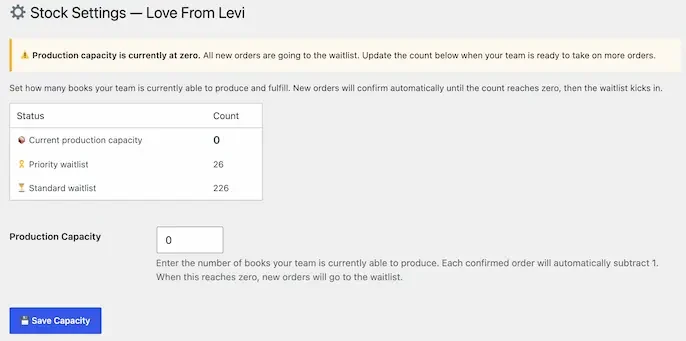
In the two weeks after it went live, Love From Levi shipped 15 books and kept every remaining request organized and visible. No third-party order plugin to babysit, no manual sorting. That is what web development means on this page: the site already existed, and we made it do the thing the organization needed. The full write-up is in the Love From Levi case study.
Team 218 doesn't always get seen in the day-to-day, but they are always there for us: solving problems, building systems, and helping us continue Levi's mission in ways we couldn't do on our own.
Love From Levi, in its Champion Spotlight post about Team 218
A second example: a 130,000-part search for Aerial Specialists
Aerial Specialists in Racine, Wisconsin supplies OEM parts for aerial lifts: scissor lifts, boom lifts and personnel lifts from 31 manufacturers. Their catalog runs to more than 130,000 part numbers. A customer with a lift down does not want to browse that. They want to type a part number, or pick the manufacturer and a keyword, and get an answer.
Before this, the parts page was a list of part numbers and a phone call. We built the parts search over two weeks as a custom WordPress plugin with its own search endpoint. It works the way the parts desk works:
- Search as you type. Filter by manufacturer, or search all 31 at once by part number or keyword. Results come back from the plugin's own endpoint rather than from WordPress posts, so a search across 130,000 rows is quick.
- Build a list, not a cart. Lift parts are quoted, not priced on a page. The customer clicks Add next to each part, then sends the whole list with their contact details in one Request Quote form.
- One request, one reply. The quote request reaches the parts team with every part number already on it, so nobody retypes anything.
That is development in service of a sales process that already worked, rather than a store forced onto a business that does not sell by cart. The company's president said it in a Google review: "Team 218 has stepped up time and time again. Finally someone that knows and understands OUR industry."
Why build custom functionality on WordPress?
Because you own it. A booking system or store built inside a closed platform belongs to the platform; raise the price or shut the feature down and you start over. WordPress runs on hosting you control and the code is yours. Thousands of developers in the country can work on it if we are ever not the right fit. We say that on the WordPress for Iowa businesses page too, because it is the main reason we build on it.
The second reason is that most of what a small business needs already exists as a well-maintained component. WooCommerce, Gravity Forms and the major booking and membership plugins are used on millions of sites. Development work for us is mostly configuring, extending and connecting those components correctly. We write custom code only where nothing off the shelf does the job, and then we keep all of it updated. That is cheaper and far more reliable than writing everything from scratch.
The third reason is maintenance. Custom functionality that nobody maintains breaks the first time a payment gateway changes its API. Every site we build includes 12 months of our WordPress care plan, so the person who built the integration is the person watching it.
How does a web development project work with Team 218?
- Discovery call. You describe what the site has to do and what it connects to. We ask about the systems you already use, who will maintain the content, and what happens when something goes wrong at 5 p.m. on a Friday.
- Written scope and fixed price. You get a document that lists each piece of functionality, how we will build it, and the total cost. No deposit. Nothing is billed until the site launches.
- Build on a staging site. You can log in and test every form, every booking flow and every checkout while we work. Integrations are tested against your real accounts in test mode.
- Launch. Content migrated, redirects in place, forms and payments confirmed live, Search Console and analytics connected.
- 12 months of care, included. Updates, daily backups, security monitoring and minor changes. After the first year the plan continues at $60 a month if you want it to.
The full eight-step build process, including the pre-launch checklist, is on the Iowa web design page. Development projects follow the same steps with more time in the build and testing stages. Most of our builds take four to six weeks from kickoff to launch; development-heavy projects run longer, and the written scope gives you the date.
How much does web development cost in Iowa?
Our custom WordPress builds run from $2,500 to $8,000, and development-heavy projects sit in the upper half of that range. What moves a project up the range is what the site has to do and how many systems it touches, not how many pages it has. A five-page site with a quoting engine connected to your CRM costs more than a fifteen-page site that only needs to look right and rank.
Three things keep the number honest. We quote the whole project before starting, so there is no hourly meter. We tell you when a plugin that already exists will do the job instead of custom code. And we tell you when what you are describing is not a website project at all. The pricing page has the ranges for every service and explains how we decide where a project lands.
Where do we do web development work?
Team 218 is based in Williamsburg, Iowa, and works with businesses across the state. Development work is done remotely with screen-shared reviews, so distance has never been a factor. We meet in person when a project calls for it. Each city below has its own page, and the case studies show finished projects.
Frequently asked questions about Iowa web development
What is the difference between web design and web development?
Web design is how a site looks, reads and guides a visitor to act. Web development is the functionality underneath: forms that calculate, booking systems, online stores, logins and connections to other software. Every Team 218 site gets both; the label describes where most of the hours go.
Do you build custom plugins?
When nothing that exists does the job, yes. Most of the time the right answer is a well-maintained existing plugin, configured and extended properly. Custom code is written only where it earns its place, because every line of it has to be maintained.
Can you connect my website to the software I already use?
Usually. QuickBooks, Mailchimp, HubSpot, Google Calendar, Stripe, Square and anything with a Zapier connection are routine. For industry-specific systems we check the API on the discovery call and tell you before quoting whether it is practical.
Can you add functionality to a site you did not build?
Yes, after an assessment. If the existing site is sound we add to it. If it is not, we tell you, because building a booking system on a site that is already failing wastes your money. Our WordPress repair service covers the assessment.
Will I be able to update the site myself?
Yes. Content, products, events and staff listings are built so that non-technical staff can maintain them from the WordPress dashboard. We walk you through it at launch, and the care plan covers minor changes you would rather hand off.
Do you require a deposit for development projects?
No. We have never taken deposits. You receive a written scope and fixed price, and nothing is billed until the site launches.
Tell us what the site has to do
Describe the functionality in your own words and we will tell you how we would build it, what it would cost, and whether a website is the right tool for the job.
Or call or text 319-333-0815.